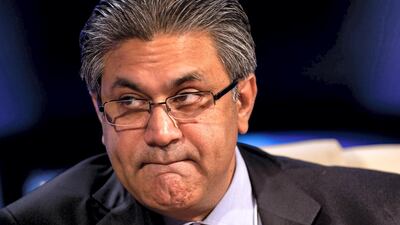
Liquidators overseeing Abraaj Group’s insolvency now estimate chief executive Arif Naqvi’s alleged theft to have cost the firm $385 million (Dh1.41 billion), an amount significantly more than what prosecutors claimed.
Mr Naqvi is one of six former Abraaj executives who face charges stemming from the private equity’s firm’s 2018 collapse. In court papers last year, US prosecutors said Mr Naqvi stole more than $250m. But in a new filing on Friday, the liquidators put the losses much higher, claiming Mr Naqvi stole $385m from 2009 to 2018 as he moved money for his own use in more than 3,700 transactions.
The liquidators are at work trying to trace the transactions and have asked a New York judge for permission to file subpoenas on 18 banks. The information will be used in a planned lawsuit in the Cayman Islands seeking to recover funds to pay the firm’s investors and creditors.
Abraaj managed more than 40 private equity funds and assets of more than $14bn until it crumbled in the biggest failure for a private equity firm. Mr Naqvi, who has denied wrongdoing, is under house arrest in London facing possible extradition to the US. His lawyer did not respond to an email seeking comment after business hours in the UK.
Another executive, Mustafa Abdel-Wadood, a former managing partner, was arrested while on a college-shopping trip to the US with his wife and son. He pleaded guilty and is awaiting sentencing in September. Other defendants charged in New York are outside US custody.
Abraaj, which was founded in 2002, was the Middle East’s biggest private equity fund and one of the world’s most influential emerging-market investors, with stakes in health care, clean energy, lending and real estate across Africa, Asia, Latin America and Turkey.
Dubai’s financial regulator has fined Abraaj $315m for deceiving investors and misappropriating their funds.
The case is In re Application of Abraaj Investment Management Ltd., 20-mc-00229, U.S. District Court, Southern District of New York (Manhattan).

Six pitfalls to avoid when trading company stocks
Following fashion
Investing is cyclical, buying last year's winners often means holding this year's losers.
Losing your balance
You end up with too much exposure to an individual company or sector that has taken your fancy.
Being over active
If you chop and change your portfolio too often, dealing charges will eat up your gains.
Running your losers
Investors hate admitting mistakes and hold onto bad stocks hoping they will come good.
Selling in a panic
If you sell up when the market drops, you have locked yourself out of the recovery.
Timing the market
Even the best investor in the world cannot consistently call market movements.
How to report a beggar
Abu Dhabi – Call 999 or 8002626 (Aman Service)
Dubai – Call 800243
Sharjah – Call 065632222
Ras Al Khaimah - Call 072053372
Ajman – Call 067401616
Umm Al Quwain – Call 999
Fujairah - Call 092051100 or 092224411
Who's who in Yemen conflict
Houthis: Iran-backed rebels who occupy Sanaa and run unrecognised government
Yemeni government: Exiled government in Aden led by eight-member Presidential Leadership Council
Southern Transitional Council: Faction in Yemeni government that seeks autonomy for the south
Habrish 'rebels': Tribal-backed forces feuding with STC over control of oil in government territory
The Settlers
Director: Louis Theroux
Starring: Daniella Weiss, Ari Abramowitz
Rating: 5/5
Sukuk explained
Sukuk are Sharia-compliant financial certificates issued by governments, corporates and other entities. While as an asset class they resemble conventional bonds, there are some significant differences. As interest is prohibited under Sharia, sukuk must contain an underlying transaction, for example a leaseback agreement, and the income that is paid to investors is generated by the underlying asset. Investors must also be prepared to share in both the profits and losses of an enterprise. Nevertheless, sukuk are similar to conventional bonds in that they provide regular payments, and are considered less risky than equities. Most investors would not buy sukuk directly due to high minimum subscriptions, but invest via funds.
The%20Boy%20and%20the%20Heron
%3Cp%3E%3Cstrong%3EDirector%3A%C2%A0%3C%2Fstrong%3EHayao%20Miyazaki%3C%2Fp%3E%0A%3Cp%3E%3Cstrong%3EStarring%3A%3C%2Fstrong%3E%C2%A0Soma%20Santoki%2C%20Masaki%20Suda%2C%20Ko%20Shibasaki%3C%2Fp%3E%0A%3Cp%3E%3Cstrong%3ERating%3A%20%3C%2Fstrong%3E5%2F5%3C%2Fp%3E%0A
UAE currency: the story behind the money in your pockets
SPECS
Nissan 370z Nismo
Engine: 3.7-litre V6
Transmission: seven-speed automatic
Power: 363hp
Torque: 560Nm
Price: Dh184,500
VEZEETA PROFILE
Date started: 2012
Founder: Amir Barsoum
Based: Dubai, UAE
Sector: HealthTech / MedTech
Size: 300 employees
Funding: $22.6 million (as of September 2018)
Investors: Technology Development Fund, Silicon Badia, Beco Capital, Vostok New Ventures, Endeavour Catalyst, Crescent Enterprises’ CE-Ventures, Saudi Technology Ventures and IFC
